Learning about Subsistence Practices & Environmental Advocacy

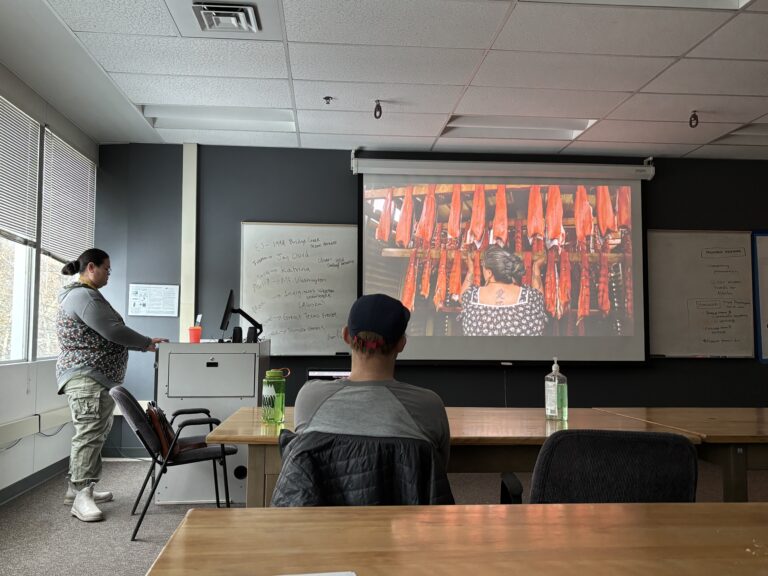
On a sunny day in February, Dr. Marchioni began lowering the blinds in her east-facing classroom in Grant Hall so that the projection screen is easy for students in her Culture and Environment class to see. Today’s guests, Lani Strong Hotch (Chilkat Weaver and Culture Bearer) and her husband Jones Hotch (Tribal Council President of the Chilkat Indian Village), are joining the class online from their home in the community of Klukwan, a Tlingit community in Southeast Alaska more than 700 miles from Anchorage.
Hearing from Lani and Jones and learning about their subsistence practices has become a regular feature of Marchioni’s APU class. Each year, the couple has awed students with a presentation that includes image after image of community members salmon fishing, berry picking, dancing, and participating in one of Klukwan’s many culture camps. And each year the couple offers updates on the Palmer Project, a roughly 100,000-acre mining prospect containing deposits of copper, zinc, silver, barite and gold. The exploration site is located 17 miles upstream of Klukwan.
Ever since Marchioni’s students began learning about the Palmer Project and its effects on the area’s environment and subsistence way of life, the Hotch’s have Zoomed in to explain how hard-rock mining directly threatens their ways of life. The activism of Chilkat Indian Village and other local groups has been told in news articles and by non-profit agencies. In an online feature published in 2019, the outdoor gear company Patagonia highlighted the mining project and activists working to stop it. From Lani and Jones Hotch, Marchioni’s students are hearing how Chilkat Indian Village leads the fight to protect the Chilkat Valley Watershed, mobilizing Chilkat Valley residents and visitors to stop the mine’s construction and operation.
It’s not a new fight: The Hotch’s are among activists who’ve opposed the Palmer Project since it was announced in 2006. Alaska Native people seeking to stop the project say they’re upholding the land stewardship tradition of their Tlingit ancestors stretching back millennia.
Marchioni’s students prepare for discussions by learning about mining activities with potential to alter ecosystems that support salmon, a heritage subsistence food. They study ways that human health and well-being are tied to the natural environment. Students also consider the role of precious metals in the global economy, including their use in technology, construction, and electricity generation. Consumer items like phones, laptops, tablets and cars are among everyday goods that depend on mining for product upgrades.
Now in its fifth year as an APU undergraduate offering, the course prompts students to consider tradeoffs between safeguarding the environment and planned product obsolescence. “Many students say they’d prefer to use devices and cars that last longer if it brought about a reduced need for mining and its negative impacts,” Marchioni said.
Hearing from Lani and Jones and glimpsing their images of subsistence life in remote Southeast Alaska have had an impact of their own. Students who took the class five years ago are at work today in professions that involve environmental preservation.
“They still ask about Lani and Jones,” Marchioni said. “They want know to how the Chilkat River is doing.”