From Chefornak to Capitol Hill: Moses Marr’aq Wiseman’s Journey of Advocacy
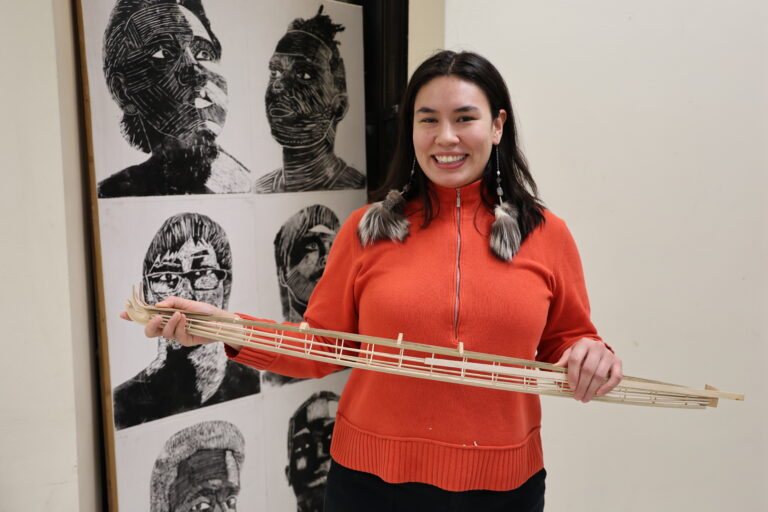
At 24 years old, Moses Marr’aq Wiseman is already a powerful voice for language access and cultural revitalization in Alaska.

Raised in the Village of Chefornak in a close-knit Yup’ik community, Moses grew up surrounded by language, family, and tradition. The son of Victor Yuralqiq and Leona Kilirnguq Wiseman, and the grandson of Dennis Nakrialnguq and Adeline Kaagyugaq Panruk, and Charlie Anartuaq and Josephine Inarayuli Wiseman, he carries forward a deep commitment to his people. Outside of work and school, he enjoys Yup’ik dancing with relatives and spends as much time as he can with family, grounding himself in the culture he works to strengthen every day.
Today, Moses serves as Alaska Native Languages Program Director at the Alaska Institute for Justice, where he oversees translation and interpretation services for multiple Yup’ik dialects, working alongside the Language Interpreter Center to help create language access plans. His goal is to expand access to Iñupiaq, Athabaskan, and other Alaska Native languages as well.
For Moses, language access is about more than translation — it’s about autonomy.
“Language access should always be accessible because language access means autonomy, heavily. When you understand what you are putting yourself into—what you’re signing up for — you’re able to make autonomous decisions for yourself, your family, and your relatives.”
Two years ago, he helped launch a major language access project focused on behavioral and mental health terminology. The first phase, a living glossary funded by the State of Alaska Health Department, includes carefully developed definitions and audio recordings, which you can now find online here. The second phase will expand into common healthcare questions and diagnostic terms, including explanations of how diseases occur and the science behind them.
“It’s an ongoing project,” he explains. “It’s a living glossary that evolves as we’re going.”
The work requires persistence and adaptability. “To be patient,” he says of what he’s learned. “You have to be able to pivot most of the time.”
Moses’ leadership extends far beyond Alaska. He was recently selected as a Champion for Change through the Center for Native American Youth, a national initiative highlighting young Native leaders across the country. As part of the program, he traveled to Washington, D.C. this past February, where he met with policymakers, participated in advocacy training, and attended the 2026 State of Indian Nations address hosted by the National Congress of American Indians. He also sat in on a Senate Committee on Indian Affairs hearing on Native 8(a) federal contracting and met leaders such as Amber Ebarb and Sharice Davids. “I never realized how huge this was until I went to D.C.,” he reflects. “I sat in on many interesting and important conversation, so I felt so lucky to be a part of it.”
Moses’ path hasn’t been linear. After attending boarding school for two years and graduating in his village, he initially wanted to leave Alaska. He earned his Bachelor of Arts from the College of Saint Benedict and Saint John’s University, where he first realized advocacy could be a profession while raising awareness about his college’s history as an industrial boarding school. He interned with Calista Corporation in education and culture, external affairs, business development, and government relations — learning how to translate, transcribe, and connect Tribes with corporate leadership.
Today, he is pursuing his Executive Master of Business Administration in Strategic Leadership at Alaska Pacific University. He values the program’s real-world application, from Harvard Business School case studies to presentations from leaders from Alaska Native Corporations.
“What I like about it is that it’s applicable,” he says. “My professors use real-world things.”
Supported in part by the Alyeska Native Scholarship, Moses says financial assistance has made a meaningful difference in his academic journey. “Scholarships have impacted my studies a lot. They’ve released the financial burden that I have with school. I think school should be free for everyone. Everyone should be entitled to their education, and I live and stand by that.”
Looking ahead, Moses hopes to step further into leadership, with interests in federal contracting and a deeper exploration of ANCSA and Tribal sovereignty. His platform is clear: language revitalization, cultural equity, and Indigenous representation. In a state where 22% of the population is Alaska Native and 16% speak a first language other than English, he believes bridging language gaps is essential.
“Access can mean a lot of things,” he explains. “In my definition, you’re bridging that gap. You’re allowing language to access all of these services that are provided to a regular American.”
His advice to fellow students is to, “Understand where you come from. Embrace who you are. And learn to understand that it’s okay to be okay — to meet yourself where you are and not give yourself such a hard time with such high expectations.”
Through his advocacy, leadership, and scholarship, Moses Wiseman is not only preserving language, he is helping shape a future where Alaska Native communities can thrive on their own terms.