Octopus fingerprints: Taking a dive into the world of pygmy zebra octopuses
The APU aquarium laboratory is located on the third floor of Grant Hall, filled with the sound of humming water pumps, gurgling tanks, and a permeating scent of a seaweed-filled beach at low tide. There are over a half dozen enclosures in the lab, each set for a different purpose. Some are homes for fish, mangrove saplings, red pacific octopuses, or sea urchins, and others serve as quarantine tanks for new specimens. In 2022 and 2023, the aquarium lab was home to 16 pygmy zebra octopuses, or Octopus chierchiae. For Abrianna Lance, a 20-year-old senior at APU, these octopuses were the focus of her senior project due to their unique patterning.
“The goal of the research is to figure out, basically, how the individual patterns might relate to phenotypical heredity,” Lance said, meaning that patterns found on octopuses could be traits that are passed on through DNA. If the stripe patterns found on pygmy zebra octopuses are hereditary, it means that groups of sibling octopuses should have similar striping patterns, which is what Lance and the project advisor, Marley Loomis, were observing. Based on preliminary results, there are indications that the striping patterns do have correlations in cohorts of related octopuses.

Full-grown zebra pygmy octopuses are hardly larger than a golf ball, and the specimens used in Lance’s project were about a centimeter in width. The species is an up-and-coming subject in aquarium biology due to their ability to lay multiple clutches of eggs. Zebra pygmy octopuses are becoming valued for neuroscience, biomedicine, and engineering research.
The species is integral to Lance’s project because of their chronic patterning. This is unlike many other species of octopus, whose entire body colorations, including patterns, are known to change. The stripes that pygmy zebra octopuses are born with remain present on their body for their entire life, even if other pigment cells in their body shift coloration.
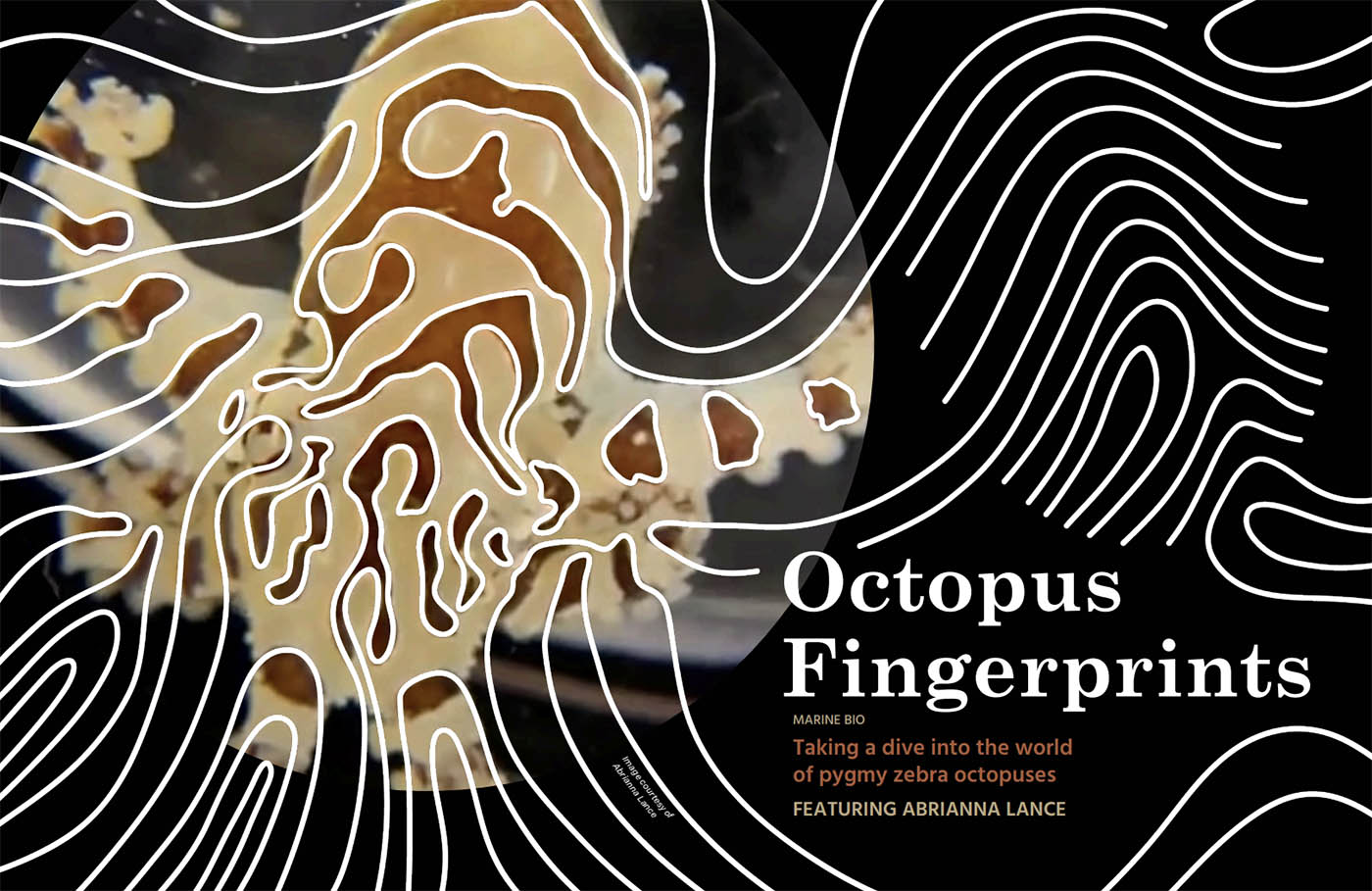
“The stripes are always there and they’re always the same,” Lance said, clicking through files on her laptop to pull up an image. Like a fingerprint, these octopuses have been found to have markings that can be used to distinguish individuals.
Lance, with an excited expression amplified by large-framed glasses, described how she began work with zebra pygmy octopuses in 2022 by creating an identification booklet for Loomis, who was a coordinator for the APU aquarium at the time. The booklet explained how to identify each of the pygmy zebra octopuses based on their patterning, complete with all relevant information needed on the octopuses, such as their sexes.
When Lance originally began looking into research of pygmy zebra octopuses, there were no naming conventions for the variations of stripe patterns. Lance worked with David Scheel, an APU professor and internationally ranked ecologist specialized in octopus behavior, to document, categorize, and name stripe patterns. Lance classified 24 patterns such as circles, horseshoes, or branching lines that appear on the front of the octopuses. She then used the new names to identify features across sibling octopus groups in her senior project.

To collect data, cohorts of egg clutches were reared in aquarium laboratories, with each octopus being kept in a separate acrylic cube in a communal tank. The study involved 26 octopuses, with 16 living in the APU aquarium lab and 10 staying in the Marine Biology Laboratory at the University of Chicago. The octopuses in the APU lab were fed prawns up to two times a day and had enrichment toys exchanged on a weekly basis. The 10 octopuses from MBL were included after the preliminary 16, providing a larger sample of specimens to study. Lance said a lot of the time early in the project was spent cleaning the aquarium and ensuring the octopuses were healthy.
Data collection would occur when an octopus was removed from its acrylic cube and transported to a petri dish with salt water. A camera and macro lens were used to capture high resolution photos of the octopuses every month or so.
“They were super active little guys,” Lance said. The lab team had to corral the octopuses with the end of a zip tie to keep them from escaping the petri dish. “They’re just like little toddlers,” she laughed.
From the photography, Lance digitally traced over the octopuses’ stripes to provide clear representations of the patterns on each subject. She used Adobe Illustrator, an industry standard for artists, which was made accessible using grant money from the Indigenous One Health grant. The diagrams of octopus stripes were examined and identified to see if pattern features were present, and each octopus was scored for similarity alongside its siblings and the other clutches.
“Right now we’re looking at statistics that will help us pull out exactly how similar they are to each other,” Lance said. Several cohorts of octopuses look alike, but some statistic models indicate a less definitive story.
For example, one statistical model showed groupings of octopuses that didn’t correlate when compared to the entire set of data. Lance says she is now trying a model that includes more variables and cross-comparison between specimens, known as a correlation matrix.
“The thing with science is that you can’t force something to be there if it’s not there,” Lance said. One of her biggest struggles with the project is accepting that the results might not yield revelations for the scientific community, but she understands that a new discovery is not the only important outcome in research.
“Science is not always about failing and achieving. It’s about doing the science and publishing the results and getting the results out there, whether or not they’re what you expected.”
Article written by graduating student Laura Ditto as part of her senior project, Science in Progress: Reporting on Research at APU.