Rewriting Justice: An Indigenous Restorative Justice Approach to Healing

When you meet Lu-Anne Haukaas Lopez, it’s no surprise to learn she serves as the Deputy Executive Director of the American Civil Liberties Union (ACLU). What may be more unexpected is that she also graduated this summer with a Master of Fine Arts (MFA) in Creative Writing.
“I truly believe that art is important and it grows even more important when things like authoritarianism are on the rise,” she says.
Creative writing has become the space Lu-Anne returns to for balance amid the daily grind. “Once you get past the writer’s block and into the flow, creating art feels almost sacred,” she explains. “Maybe it connects you to something bigger and more beautiful, a reminder that there’s more beyond the daily challenges we face.”
Lu-Anne began her master’s degree at the University of Alaska Anchorage but stepped away and couldn’t return before the program closed. Later, she heard MFA Program Director Dave Onofrychuk speak at a library fundraiser, an encounter that reignited her belief that she could finish the dream she had already worked so hard to achieve.
A Sicangu Lakota and Mestiza woman born in Colombia, Lu-Anne immigrated to the United States at four years old to escape ongoing war in her birth country. She grew up in Interior Alaska in a subsistence-based commune, an experience that continues to shape her today.
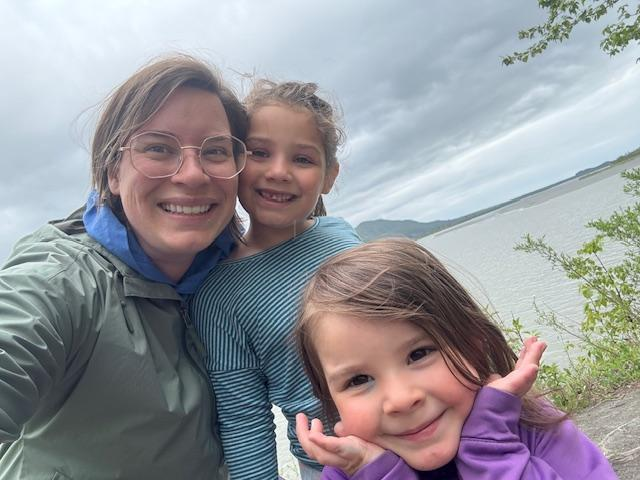
When asked what she enjoys doing in her free time, she speaks lovingly of visiting family who still live in that region and spending time with her husband and children. “There’s nothing better than being out in Alaska with the people I love,” she says. “I especially treasure harvest season; it brings me back to the subsistence lifestyle I grew up with. There’s something deeply satisfying about gathering food for winter, feeling prepared, and sharing it with your loved ones.”
For her thesis, Lu-Anne explored Indigenous Restorative Justice as a theoretical framework within nonfiction. Her creative work, Burnt Offerings and Peace Offerings, weaves together stories of growing up in various communes and navigating personal, historical, and communal traumas. Her critical paper, Speaking of Monsters: Indigenous Justice as a Measure in Nonfiction, examines Indigenous Restorative Justice as an artist’s practice, particularly a writer’s practice, through the lens of nonfiction writing.
Prior to the ACLU, much of Lu-Anne’s career has been spent at Southcentral Foundation, where she was a part of leading healing work across Alaska and Indian Country and where she often witnessed the need for restorative approaches in communities still grappling with the consequences of colonialism. Indigenous restorative justice, she explains, is a holistic process rooted in Indigenous traditions that seeks to repair harm, heal individuals, and restore balance to the community.
“It’s a communal approach to justice that involves both healing and accountability,” she says. “One is not in opposition to the other. Justice cannot be a binary or either punishing the person who caused harm or supporting the person who experienced it. It must be about the whole community coming together to heal each other.”
She notes that this framework aligns more closely with Indigenous feminism than with Western feminist models, because of its focus on interdependence and communal well-being. In this view, if one person is treated inequitably, “the entire community is sick, because in a whole community, everyone is treated with dignity and equity,” she says. Healing becomes a collective act rather than an adversarial one, countering a pattern that recurs throughout Western frameworks.
A crucial part of this process is the accountability of the person who caused harm and the recognition that harm often stems from that person’s own trauma. Addressing root causes, she explains, is essential for genuine healing.
Once at a conference in D.C. on historical trauma, Lu-Anne served on a panel with Alaska Native Elders. One Elder, Rose Dominick from Western Alaska, shared a truth with Lu-Anne that has stayed with her: “In order for the sacred circle to mend, everyone must be a part of it—even those that broke it.”
Community is at the heart of Alaska Pacific University as well, and Lu-Anne felt that deeply. “My experience has been that the faculty and the system are so supportive of students’ success,” she reflects. “It’s a system that evolves with and for its students, and not the other way around. I tell people now, ‘Don’t sleep on APU. It’s been the best thing to happen on my education journey so far.’”
The summer intensives stand out as one of her most memorable experiences within the MFA program. The community was tight-knit, inspiring, and filled with creative energy.
Her time at APU isn’t done. This fall, Lu-Anne enrolled in the Alaska Native Executive Leadership Program (ANELP). “I feel fortunate to be apart of it,” she says. “As a leader within Alaska’s justice landscape and as a Native person living here, I think it’s imperative that our leaders seek first to learn from the Land we live on and from the wisdom of its First Peoples.”
She shares this advice with future students: even if life pulls you away, don’t be afraid to return to what you love and finish the path you started. Speak up for yourself, your needs matter, and you’ll find faculty at APU who genuinely listen and care. And if you’ve been toying with the idea of joining the MFA program, she says simply: you should do it.