The mysteries of otter diving: Morgan Vanzant uncovers sea otter diving behavior

Across the waterways of Southcentral Alaska, sea otters with thick coats of fur, coarse whiskers, and iconic diamond shaped noses swim around the coasts, scavenging and hunting for meaty underwater treats. Many people know of sea otters, or Enhydra lutris kenyoni, as the critters that hold hands while sleeping and break open shells by smashing them with rocks. Butthese cute, surface-level behaviors—so endearing to people—make up only a portion of sea otter lives.

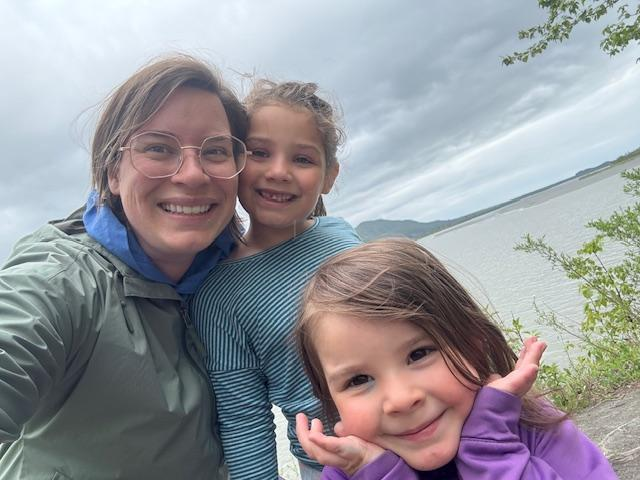
Sea otters spend most of their time under water foraging for their next meal. APU student Morgan Vanzant, 22, is working to discern factors that affect the timing of these dives, especially when considering pup presence with female otters. She is using Microsoft Excel to do a comparative study identifying how the presence of pups affects female otter dives.
“Sea otters have such a high metabolism they have to eat a quarter of their body weight aday when they’re not lactating or have a pup,” Vanzant said. She is unpacking a dataset that holds more than 5000 sea otter observations to complete her research.
Before formatting data into graphs and analyzing results, Vanzant must process the dataset by removing any duplicate entries, look at dive-time averages to understand otter habits, and organize the data into categories, such as pup sizes.
“I’m specifically looking at dive times of females with no pups, and then I’ll compare it to females with small, medium or large pups,” Vanzant said. “You can kind of make the assumption if it’s a longer dive, they’re probably going deeper and getting something that has higher energyvalue.”
The data are from over eight years of observations made by United States Geological Survey researchers from 2007 to 2023. Researchers documented otters from Katmai National Park, Prince William Sound, Kachemak Bay, and Kenai Fjords National Park, keeping track ofotters’ sex, dive times, rest times, and pup presence and size, among other variables.

Vanzant explained that some entries in the dataset would include types of food that were caught or what the otters did with the food, but such information could not always be noted.
It takes at least 13 weeks for a newborn otter to be able to dive, so Vanzant originally believed that females with smaller pups would have shorter dive times to limit how long they spent away from their offspring. “But I’m seeing that they might actually do longer dives because they need more food or more rich-in-nutrient food,” Vanzant said.
She noted that preliminary findings show pup-laden females could have more frequent dives. And, despite the fact that research has shown male otters having longer dives, Vanzant saw that female otters in Kachemak Bay had slightly longer dive-times than males.
Vanzant began looking at otter data in early 2023, when her academic advisor, Professor Nathan Wolf, put her in touch with Kim Kloecker, a biologist at USGS, Anchorage. Working with Kloecker, Vanzant tidied up a set of data, organizing the entries to be entered into the USGS system. Now, Vanzant is continuing to work with Kloecker as she interprets otter diving habits.
“The senior project is a little bit more self-paced. I think it’s a good way to get students in the process of science,” Vanzant said. “It’s great I’m getting to work with Kim at USGS. She’s been introducing me to people and helped me see what real science is like.”
For Vanzant, a love of animals brought her into the sciences.
“I grew up with pets, so that kind of started my love for animals,” Vanzant said, recalling her experience in high school volunteering at the Alaska Zoo petting zoo and as a husbandry assistant. “Another thing that got me more into the marine side is I really like the ocean. I like being in the water,” she added, mentioning that she received her scuba diving certification through APU and participates in community events like the Whittier Harbor cleanup.
Vanzant attended Washington State University in 2019 but came to APU after the COVID-19 pandemic began. She is scheduled to graduate in spring 2023 with a bachelor’s degree in marine and environmental science with a concentration in marine biology. Once Vanzant finishes her data analysis, she will share her findings with USGS biologists and sea otter-ecology experts who will draw further conclusions from Vanzant’s results.
Article written by graduating student Laura Ditto as part of her senior project, Science in Progress: Reporting on Research at APU.