On the Ice: APU Students Measure Alaska’s Changing Climate
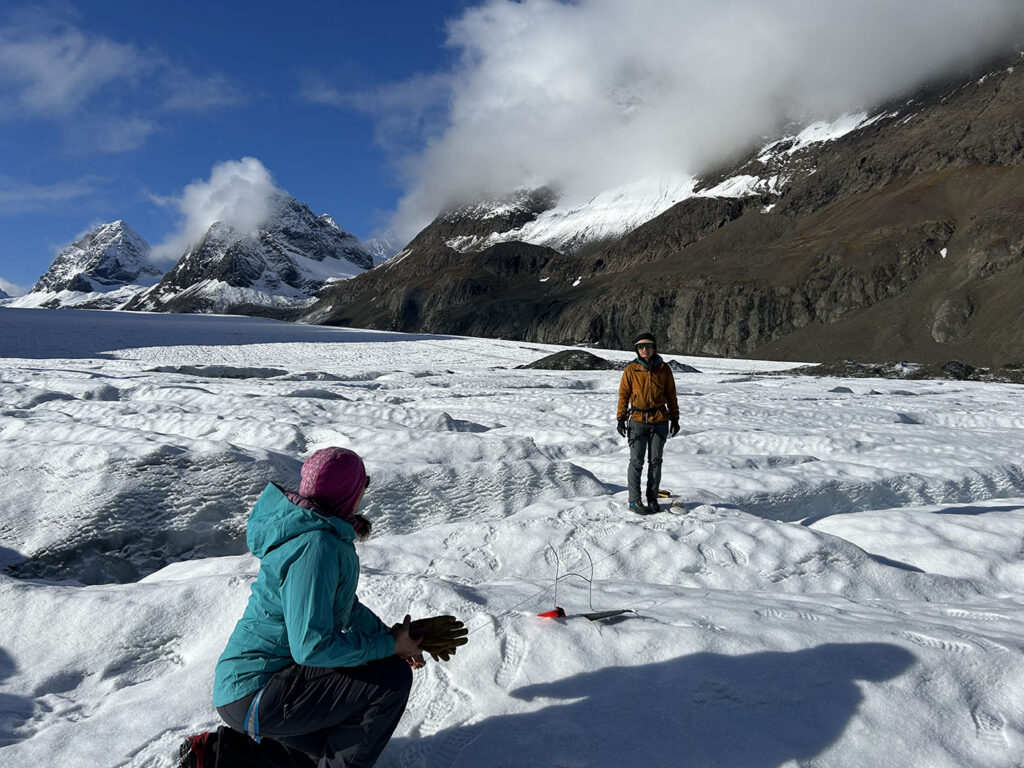
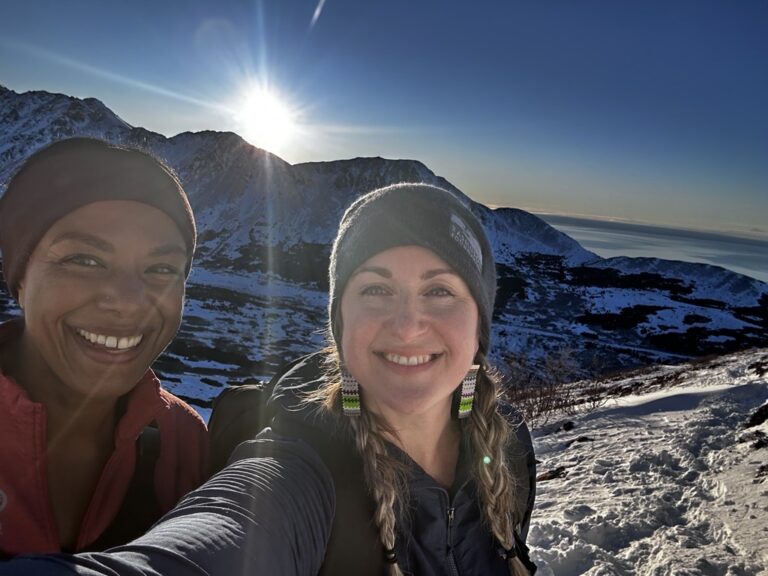
Each spring and summer, while most classrooms are winding down for the semester, another classroom comes alive nearly 4,500 feet above sea level. On the ice-covered expanse of Eklutna Glacier in Alaska’s Chugach Mountains, Alaska Pacific University students shoulder backpacks loaded with scientific equipment and ski across snowfields alongside APU Professor Dr. Jason Geck. Their destination isn’t simply a scenic overlook but rather it’s one of Alaska’s most important long-term climate monitoring sites.
Here, students aren’t learning about glaciers from a textbook. They’re collecting the data that helps scientists understand how one of Southcentral Alaska’s most critical water sources is changing.
A Glacier That Sustains a City
Few Alaskans realize how much they depend on Eklutna Glacier. The glacier provides the majority of the water flowing into Eklutna Lake, which supplies roughly 80% of Anchorage’s drinking water while also generating 10-15% of the city’s electricity via hydropower generation. The Eklutna Watershed also historically supported all five Pacific salmon species, sustaining the Dena’ina Eklutna people since time immemorial. Hydroelectric development in the 1920’s and 50’s decimated these runs by blocking fish passage and decades-long efforts to restore the salmon to the Eklutna River continue to this day.
For more than a decade, Dr. Geck has led APU’s research on the Eklutna Glacier, with APU involvement in research dating back to 2008. APU professors and students have completed a diversity of projects throughout the years. On a bi-annual basis, Dr. Geck returns to the glacier with undergraduate students to study glaciology via an interdisciplinary, field-based undergraduate course and through independent student projects.
An example of a student project includes graduate student Caroline Brisbois’s project creating a preliminary assessment of the geodetic mass balance (ice accumulation and melt) from 2019 to 2020 using digital elevation models that overlay hundreds of 2-D photos to create a 3-dimensional topography map. This research monitored for impacts on Eklutna Lake water supply, similar to other studies done over the years.

Students travel by helicopter into the mountains before spending the day navigating crevasses, drilling stakes into glacier ice, measuring snow depth, collecting GPS data, and maintaining and building automated weather stations. On other days, students bike to Eklutna River to collect river discharge data in order to analyze how much water flows from the glacier in relation to the geodetic mass balance of the glacier.
The stakes installed throughout the glacier reveal how much ice has melted since the previous visit. Snow pits provide information about winter accumulation. Weather instruments record the temperature and precipitation that drive melting throughout the season, and are used for modeling purposes.
It’s physically demanding work, but it’s also exactly the kind of experiential education APU is known for. Students gain experience using professional field techniques, scientific instrumentation, GIS, remote sensing, and data analysis while contributing directly to ongoing research. Instead of practicing on hypothetical datasets, they’re creating the datasets future scientists will use.
Recent APU graduate Audrey Palmer reflects on her time working with Dr. Geck on her senior project. “Getting to work with Jason has been the highlight of my experience. He opened the door to so many opportunities—from building weather stations on glaciers to flying out and collecting field data firsthand. I’ve been able to do real, hands-on science, not just learn about it in a classroom,” she says. “He’s also been incredibly supportive of my senior project, which has grown into something quite large. Being out in the field gathering data and getting to adventure while doing it has been really great. I don’t think I would have gotten to do something like this anywhere else.”

From Field Notes to Published Research
The work doesn’t end when students leave the glacier. Back on campus, the field measurements become part of larger research efforts that combine on-the-ground observations with satellite imagery and hydrological models to understand long-term glacier behavior.
One of those projects culminated in a peer-reviewed study led by Dr. Geck that reconstructed Eklutna Glacier’s mass balance and water discharge from 1985 through 2019. The research showed the glacier has experienced a significant long-term loss of ice, an increasingly long melt season, and rising meltwater discharge driven primarily by warmer summers. For example, between 1985 and 2013, the glacier lost roughly 7% of its initial area.
The findings have practical implications. Although more meltwater is currently reaching Eklutna Lake, the increase comes from the glacier losing stored ice. Eventually, as the glacier continues to shrink, annual runoff is expected to decline. Understanding when that transition occurs is critical for future water management, hydropower planning, and salmon restoration.
Students as Research Partners
At many universities, undergraduate students may observe research from the sidelines. At APU, they become collaborators. Students help install monitoring equipment, collect field observations, process data, and contribute to projects that inform scientific publications and regional resource management. Many continue into graduate school or careers in environmental science, hydrology, GIS, natural resource management, and climate research, carrying with them experience few undergraduates receive.

For Dr. Geck, the goal extends beyond teaching students how glaciers work. It’s about teaching them how science works. Field observations, careful measurements, long-term monitoring, collaboration, and asking questions that matter to communities are all part of the process.
Research with Real-World Impact
Climate change is often discussed in terms of global averages and future projections. On Eklutna Glacier, students see its effects firsthand. They measure spring snowpack, monitor changing melt patterns, and document a glacier whose behavior directly affects drinking water, energy production, ecosystems, and recreation across Southcentral Alaska. Each field season adds another chapter to a dataset that grows more valuable every year.
For APU students, it’s an opportunity few universities can offer: conducting meaningful research in one of Alaska’s most iconic landscapes while helping answer questions that matter far beyond the glacier itself. As the climate continues to change, so will Eklutna Glacier. Thanks to Dr. Jason Geck and generations of Alaska Pacific University students, scientists, and Indigenous stewards, decision-makers will have the data needed to understand what comes next.