APU Advance a One Health Approach to Microplastics Research in Alaska
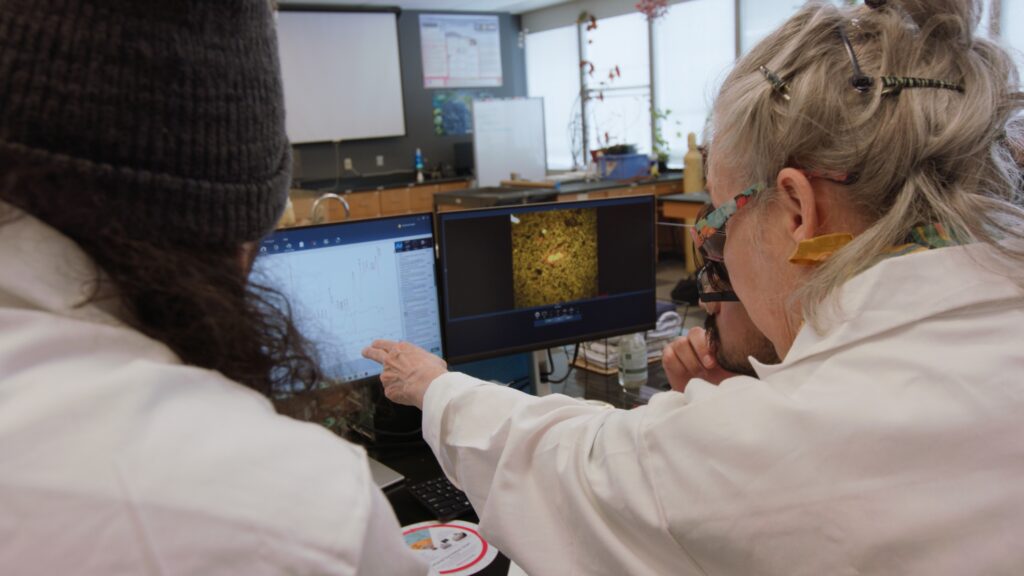
APU’s Microplastics Research and Education Center (MREC) and its Alaska and Arctic Waterways Analytics Lab (AAWA) are positioning Alaska as a leader in microplastics detection and monitoring under California Water Board regulations for drinking water. Beyond research alone, the lab is committed to building a workforce prepared to protect ecosystems, mitigate the spread of microplastics, and safeguard both environmental and human health locally and globally. While the lab is operating under a 5-year grant, researchers are positioning the lab to become self-sustaining so that it can continue to meet the needs of Alaskan communities for decades to come.
Central to this work is a “One Health” approach, which recognizes the deep connections between water quality, animal health, and human health. While increasingly embraced by researchers and policymakers across Arctic nations, this perspective has long existed within Arctic and Alaskan Indigenous knowledge systems. The upcoming 2026 UArctic Conference, for example, will feature One Health sessions on sustainable pollution regulation, plastic pollution’s effects on Arctic wildlife, and pan-Arctic environmental assessment strategies.
Braiding Traditional Knowledge and Scientific Research
At APU, this approach is taking shape through student-led research that combines Western science with Traditional Knowledge. Senior undergraduate student Tasha Uassuk Mockta is conducting microplastic detection studies comparing waterways in her home region near Bethel with urban waterways in Anchorage. Her original goal was to test traditional drinking water sources in Bethel, but her project evolved to focus on recreational waters near the airport, areas with heavy ATV traffic, and rainwater collected from her grandmother’s home.
Tasha’s work with the AAWA lab began during a Chemistry II course, though her background in water quality research dates back to 2015 when she interned with the Yukon River Intertribal Watershed Councilanalyzing water quality data. Her current research, titled Freshwater Ecology and Ellam Yua, reflects her effort to braid ancestral knowledge with scientific inquiry. In Yup’ik culture, Ellam Yua means “the person of the universe”and refers to the Creator, or universal consciousness, the spirit in all things, and to the sentience of nature.
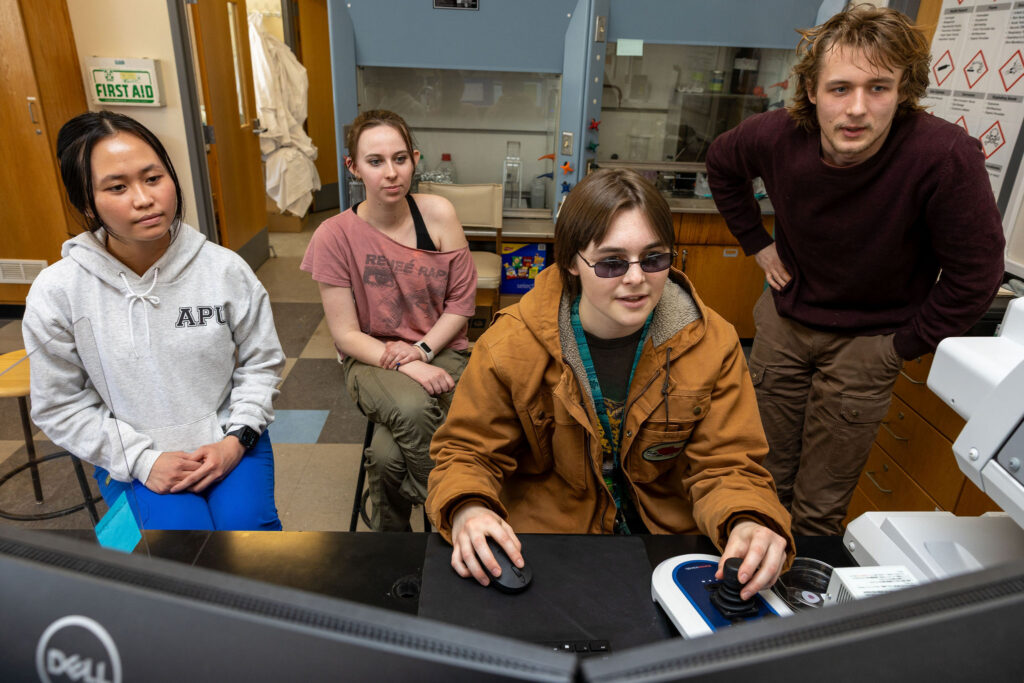
These comparisons are helping researchers better understand how microplastics move through the global water cycle, where they accumulate, and which human activities contribute to their spread. Reflecting on her experience in the lab, Tasha says, “Getting the hands-on experience has been really exciting. I was more comfortable with the fieldwork aspect, so getting the backend analytic side of things has been really cool. Being the one to filter my water sample and seeing that process has been awesome. It’s been especially exciting using the RAPTIR.”
Tasha has also served as a mentor for high school students in the Tumyaraa program who are helping analyze water samples from Gamble Creek. “I’ve really appreciated being able to work with my people in the younger generation,” she says. “I want to show the youth in Bethel that there are good opportunities to help their community without having to be there.”
Expanding Research Across Alaska’s Waterways
This summer, another senior undergraduate student, Rushyll Jane Pacoy, will begin related research on Anchorage’s Jewel Lake. Like Tasha, Rushyll Jane works full-time at ANTHC while attending APU full-time. She recently earned an Alaska Space Grant Apprenticeship that will support research combining field sampling with NASA satellite data to study airborne particulates and seasonal changes in urban aquatic systems.
Rushyll Jane plans to compare water samples collected from heavily trafficked areas of Jewel Lake with samples from more remote sections of the lake. Her work will also emphasize the integration of Traditional Knowledge and the One Health framework in understanding urban recreational waterways. “I feel like I’m doing real science with my own hands,” she says.
Advancing Ocean Sampling Techniques
Following the 2026 Spring Session, APU Co-Investigator and Field Work Scientist Nate Anderson, MSc., will lead undergraduate students Aaron Lippy and Bella Keller on a seawater sampling expedition in Smitty’s Cove. Their research aims to “close the loop” on microplastics collection practices by comparing multiple methods for collecting seawater samples.
Using a stainless-steel Niskin-type bottle alongside CTD sensors that measure conductivity, temperature, and depth, the team will evaluate how different collection techniques may influence the introduction or detection of microplastics in samples. In previous years, the lab relied primarily on samples collected by student scientific divers trained by Ben Wilkins, MSc., APU Scientific Diving Instructor and FAST Lab Associate Researcher. Because California Water Board protocols do not yet specify standardized methods for sampling ocean water at varying depths, the comparison will help researchers determine which approaches are best suited for different environmental and research conditions while minimizing contamination during collection.
Connecting Field Research with NASA Technology
Aaron and Bella will also spend the summer interning at NASA’s Jet Propulsion Laboratory in California through funding provided by MREC and the Minority University Research and Education Project Institutional Research Opportunity (MIRO). During the internship, they will study methods for collecting and analyzing data from NASA’s Surface Water Ocean Topography (SWOT) satellite system, which provides detailed information about rivers, coastlines, and oceanographic systems, including remote and difficult-to-access waterways.
Ultimately, the AAWA lab hopes to integrate SWOT data with field sampling to better understand how microplastics move through ocean currents and river systems connected to Alaska’s coastlines. Aaron reflects on the opportunity by saying, “I took the internship because it allows me to be part of real scientific work, applying what I’ve learned in school while learning from experts across a wide variety of fields. It’s awesome that, as a freshman, I have the opportunity to conduct this kind of research because following lines of inquiry and figuring out how the world works is why I chose a STEM career.”
Strengthening Partnerships and Laboratory Accreditation

Another important collaborator in the lab’s work is Steve Dykstra, Ph.D., physical oceanographer and hydrologist at the University of Alaska Fairbanks. Dykstra is helping researchers better understand the ocean-river estuarine interface and the ways microplastics move between marine and freshwater systems. Previous research suggests that microplastics do not move through the water cycle in only one direction; rather, they travel back and forth between ocean and land systems. His expertise is helping refine ocean sampling techniques and improve interpretation of how ocean dynamics shape microplastic distribution throughout the water column.
The lab’s accreditation efforts are also advancing with support from the Moore Institute for Plastic Pollution Research (MIPPR) in California, which recently completed its second accreditation cycle with the California Water Board. The accreditation process is rigorous and renewed every two years, underscoring the significance of MIPPR’s partnership with the AAWA lab. This spring and summer, MIPPR is providing advanced training in high-throughput microplastics analysis to Graduate Research Associate Kian Muldoon and MREC Principal Investigator Dee Barker, Ph.D. This training will help the lab provide faster turnaround times for drinking water analysis within the community.
A Holistic Vision for Environmental Health
In addition to laboratory research, Dr. Barker is developing methods to track the atmospheric transport of microplastics by integrating satellite data on air and ocean currents with field-based water and air sampling. Together, the work of Tasha, Rushyll, Aaron, Bella, and the broader AAWA team seeks to weave data from across the water cycle into a more complete understanding of how microplastics move through interconnected ecosystems.
At the heart of this work is the understanding reflected in Ellam Yua: that the Earth and all living things exist in deep relationship with one another. Through the integration of Traditional Knowledge, scientific research, and emerging technologies, APU’s Microplastics Research and Education Center is helping build a more holistic understanding of environmental health in Alaska and beyond.