Expediton Alaska: Learning Through Place and Perspective
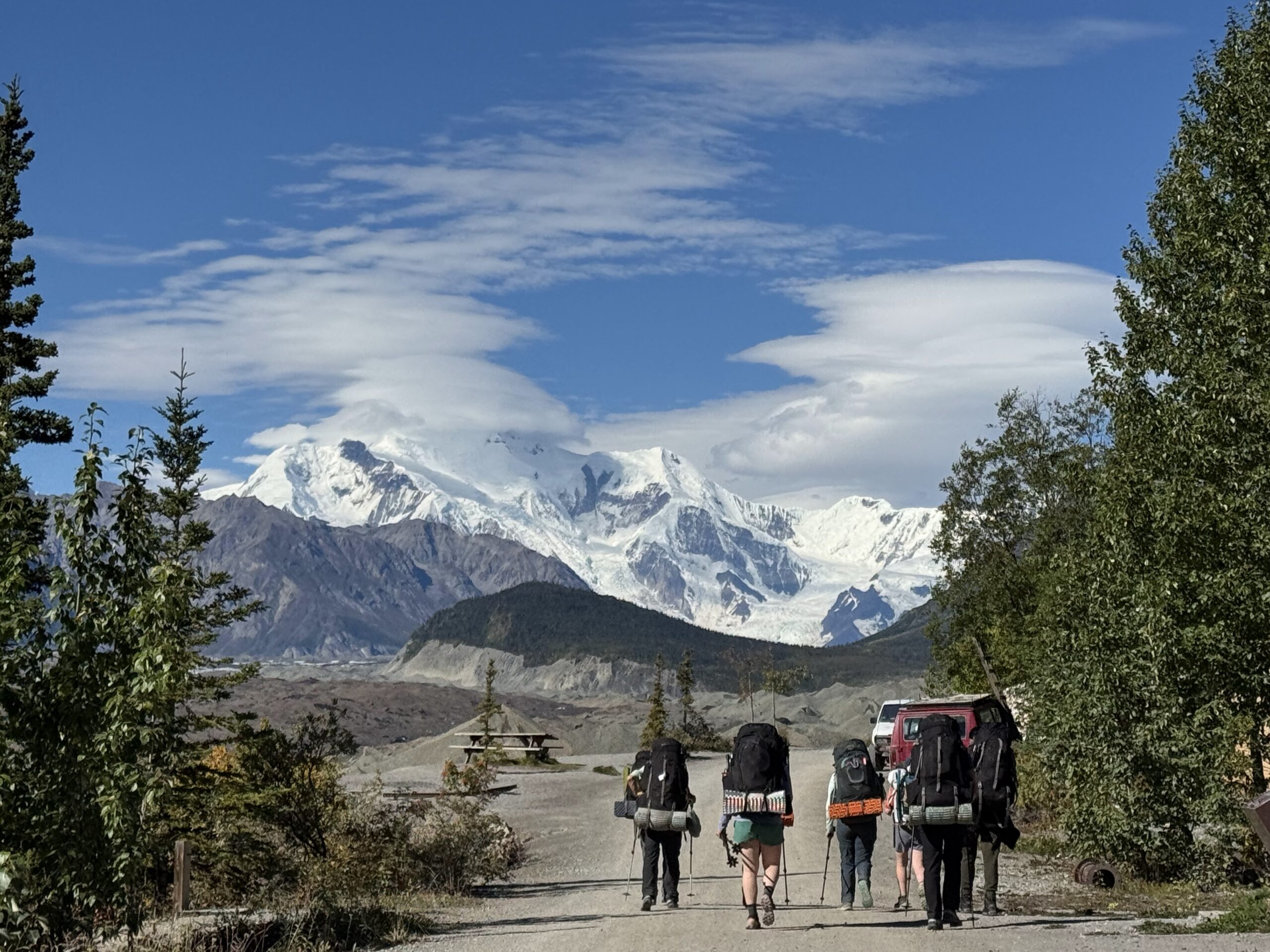
Audri Goodwine stepped out of the van and was greeted by a massive wall of ice rising impossibly high in the near distance. She and her fellow Alaska Pacific University (APU) classmates had just arrived in McCarthy, Alaska. This is an old mining town located on the ancestral land of the Lower Ahtna people. Nestled within Wrangell–St. Elias National Park, the largest national park in the country with more than 13 million acres of wilderness, McCarthy served as the starting point for Expedition Alaska, a three-week course that launches APU’s fall semester with immersive field experiences in remote parts of the state.

Intro to Wilderness students listening to a fellow student presentation about Cliff Swallows nesting in the nearby cliff, one of many lessons on local Alaskan birds!
Students enrolled in one of two classes — Natural History of Alaska or Introduction to Wilderness Skills — began their journey together before branching off into different learning paths. Though the courses had distinct objectives, both shared a common foundation: place-based learning.
Rooted in Place: What Place-Based Education Means
Place-based education uses the local community and natural environment as the foundation for learning. This hands-on approach connects students with real-world issues, encouraging deeper understanding, stronger engagement, and a lasting connection to place.
APU Professor of Environmental Sciences Nate Anderson describes it best, “The students expressed that they’d acquired a deep understanding and appreciation of the region, both through the natural and human forces that shaped the environment.”
Anderson led the Natural History course with the goal of sparking curiosity about the natural world. He guided students through field investigations in glaciology, geology, ecology, and human history, creating an experience where learning was literally grounded in the land beneath their feet.

Natural History students listen to a long-time resident of McCarthy share his expertise and experience living in
McCarthy.
Exploring the Kennicott Valley: Many Perspectives, One Place
The course began with a big-picture view of Alaska, studying the geological forces that shaped the landscape and learning about the Alaska Native peoples who have lived here for millennia. Among the first guest speakers was Wilson Justin, an Ahtna Elder born in Nabesna and a respected member of the Upper Copper River Basin. Wilson spoke about the significance of storytelling and multiple ways of knowing. In summary, he stressed that typically western depictions of the natural history of a landscape are broadly rooted in scientific research, while Indigenous stories about these same places arrive out of generational storytelling and long-term observation. Justin expressed how the Copper River Valley’s natural history accounts have multiple sides and that it’s important to stay open to all perspectives, especially those that have lived so deeply with the land for so long.
Once in McCarthy, students read an account of the Lower Ahtna people’s first interactions with Americans, particularly recounting Chief Nicolai’s role in how the area developed. This perspective offered a more complicated and detailed account compared to the one that came from the Kennicott perspective. Throughout the course, they also learned from National Park rangers, homesteaders, and local naturalists, each adding new layers of understanding.

APU students walking near the Root glacier moving past glacier mice, ball-shaped colonies of moss that move in herds across the surface of some glaciers.
These human stories were paired with environmental study: ecological succession research at the toe of Root Glacier, hydrology labs on McCarthy Creek (with samples contributing to APU’s microplastics research), glacier hikes, and a mill tour of the historic Kennicott Mine. Together, these experiences offered a holistic view of both landscape and legacy.
Into the Wild: Building Confidence, Leadership, and Skill
While the Environmental Science students focused on one location, the Introduction to Wilderness Skills group experienced three distinct environments: Kennicott Valley, the Gulkana River, and Hatcher Pass. They learned basic backcountry wilderness skills while backpacking near McCarthy, gained water-travel skills packrafting the Gulkana, and finally closed the course with a backpacking trip to Reed Lakes, where students focused on presening natural history and technical skills.

APU student Alexandra Christenson leading the group as they packraH down the Gulkana River.
While the trip itself taught many lessons, a crucial first step for any backcountry trip is logistics. APU Outdoor Studies Student and Teaching Assistant Audri Goodwine highlights this saying, “My biggest takeaway from my TA position was how much time and planning goes into logistics for a course to run smoothly — it was a great experience for me to be a part of that process and making decisions for the group.”
Students also practiced backcountry camping, orienteering, river crossings, Leave No Trace principles, and appropriate expedition behavior. All of these skills are learned while rotating through leadership roles that encourage teamwork and decision-making in the field. The goal of the course is not only to learn wilderness skills but to gain the confidence to plan and lead future expeditions, whether professionally or recreationally.
The students also presented in-the-field classes on natural history topics of their choosing. Some topics from this year included medicinal plants, cloud identification and weather, bird identification and history, and Indigenous stories with reflections posed to the group. Reflection was an integral part of the course overall, with each day ending and beginning with a debrief session.

Students starting the day with weather reports at Paxson Lake, where the group put in for the Gulkana.
Community, Reflection, and Grace in the Backcountry
Outdoor learning at APU is about more than technical skills — it’s about community. Living and learning together in the backcountry teaches patience, empathy, and adaptability.
“One of the biggest takeaways from the trip was giving everyone in the group grace,” said APU student Phillip Case. “When you’re camping together for so long, personalities and quirks come out. You just have to go with the flow.”
Daily SSTOP debriefs — short for Summary, Shout-outs, Takeaways, Open feedback, and Planning — gave students space to reflect, celebrate each other’s efforts, and plan for the next day. Lead instructor and Outdoor Programs Coordinator Duc Ngo noted, “It was really cool to hear people speak up about their experiences and to adjust as a leader. I really enjoyed that there was an atmosphere where people could communicate their hardships to the group.”

Students and instructors walking towards Lower and Upper Reed Lake
Honoring the Land and Its Stories
As the course came to a close, students returned to an essential APU value: acknowledging and respecting the Indigenous lands on which they learn.
“One thing I love about this course is creating space for people to recognize that we’re on Indigenous land,” said Ngo. “We played a traditional Native game, which was a lot of fun. In the future, I’d love to include even more of that — to help students connect with a sense of place and perspective.”
The Salmon People: Lessons in Reciprocity
A powerful moment from the trip came when Case shared the story of the Salmon People, a teaching common among many Indigenous cultures across Alaska and the Pacific Northwest.
In the story, the Salmon People live as humans beneath the sea. Each year, they don salmon skins and journey upstream, offering themselves as a gift to sustain others. This act of giving carries responsibility — to honor their sacrifice by treating salmon with respect and returning their bones to the water so their spirits can return home and be reborn.
Disrespecting the salmon, wasting their bodies or discarding their bones carelessly, risked breaking that sacred relationship. To honor the gift, many Native communities hold a First Salmon Ceremony, treating the first fish of the season with great reverence and gratitude.

Students watch as fellow students practice native games in Hatcher Pass.
“What I love about this story is how it flips our usual way of seeing things,” Case shared.
“It’s not a relationship of domination. It’s a relationship of reciprocity. They give, and we give back. And when you think about it, that’s exactly what sustainability is. Take only what you need, respect what gives you life, and never forget to show gratitude. Thousands of years before we were talking about conservation or ecology, Native people were living it through stories like this.”
Case closed with a reflection that lingered long after the lesson:
“We are traveling through salmon country at this very moment. What would change for us if we lived like the Salmon People were truly our relatives? If every fish was family, and every river was home?”