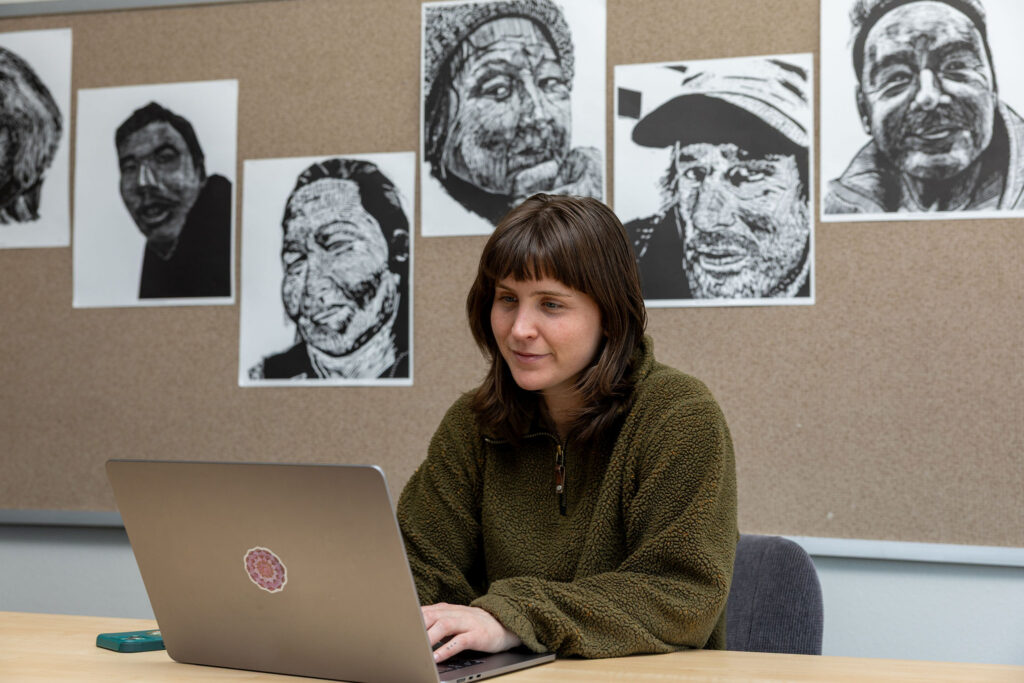
Careers in Behavioral Health
Counseling Psychology at APU is uniquely designed for Alaskans seeking a program focused on knowledge and skills that prepare them to move immediately into careers in behavioral health, addictions treatment, and other related helping fields.
This wellness, strengths, and skills-based program balances a theoretical foundation with applied, hands-on learning to make you career-ready. Students are encouraged to build connections with service agencies that lead to practicum, internship, and job opportunities.
Pathways
Counseling Psychology
Bachelor of Arts
Counseling Psychology at APU is uniquely designed for Alaskans seeking a program focused on knowledge and skills that prepare them to move immediately into careers in behavioral health, addictions treatment, and other related helping fields. This wellness, strengths, and skills-based program balances a theoretical foundation with applied, hands-on learning to make you career-ready. Service-based field trips help you build connections with service agencies that lead to practicum, internship, and job opportunities.
Whether you are a behavioral health professional needing a bachelor’s degree for career advancement or a veteran wanting to apply your military service and experience to a career in counseling, Counseling Psychology at APU is uniquely designed for Alaskans seeking a program focused on knowledge and skills that prepare them to move immediately into careers in behavioral health, addictions treatment and other, related helping fields. In addition to a traditional daytime schedule, many courses are offered during the evening or in e-learning formats to support working adults with busy lives. Students needing to pursue their degree on a part-time basis are also welcome to apply to this program. Up to 32 credits of relevant learning gained through work or other experience prior to admission can be applied toward required degree credits.
Career Opportunities
- Residential Behavioral Health Specialist
- Chemical Dependency Counselor
- Case Manager
- Mental Health Specialist
- Child Life Specialist
PY 21000 Professional Orientation and Ethics
Students begin the applied study of psychology by learning about the broad range of career directions available in the profession, understanding the challenges of psychological science and practice, and engaging in ethical decision-making processes, especially as these apply to practicing in Alaska.
PY 31000 Diversity and Social Justice
Students examine the impact of culture on human perceptions, emotions, expectations, and values. This is a skills building course that encourages students to develop greater interpersonal sensitivity and effectively advocate for social justice needs.
PY 42500 Behavioral Health Interventions
Students learn advanced skills in providing services including treatment interventions for addictive behaviors and mental health difficulties. Advanced counseling strategies are applied to prevention, rehabilitation, and remediation of distress.
Minors
The minor in Counseling Psychology can be tailored to individual student interests and career directions with attention to areas of study such as personal growth, counseling, applied psychology, and advanced research. Students work with an advisor in the Counseling Psychology Department to design the most appropriate combination of courses and academic experiences for the minor.
Degree Completion
128 credits minimum are required to complete the degree program. Core competencies, foundational, major, and self-determined studies are offered in a mixed format of:
- On-campus
- Online via synchronous learning
Mission
The mission of the Alaska Pacific University Doctor of Psychology program is to prepare culturally competent, doctoral-level psychologists who, through their practice, will help to alleviate suffering and empower individuals, groups, and communities towards health and well-being in a state with diverse populations and geographical challenges.
Program History
The APU Doctor of Psychology (PsyD) program was developed in 2011 in response to the need for doctoral-level training programs for psychologists located across the vast state of Alaska. The majority of the state of Alaska qualifies for the Health Resources and Services Administration (HRSA) designation of Mental Health Professional Shortage Area (MHPSAs), and the need for licensed, doctoral-level psychologists in the state is clear. Currently, the APU PsyD program represents one of only two training programs for doctoral-level psychologists in Alaska. The unique training model of the APU PsyD program allows it to serve students even in the most remote areas of the state.
Program Philosophy
The APU PsyD program prides itself as a unique and comprehensive training model built for the distinctive needs of students living in the geographically challenging state of Alaska. This model is based on:
Accessible curriculum
APU’s program is designed for working professionals. APU PsyD faculty members have developed an effective class structure that allows for the blending of face-to-face and technology-supported instruction to meet the needs of students separated by geography that challenges the ability to provide traditional education. Courses meet for three intensive three-day weekends and six two-hour synchronous eLearning sessions in the evening over the course of the semester. Synchronous eLearning sessions allow for content delivery while intensive three-day weekends, practicum placements, and internship allow for application of theory and technique. While this program structure does allow students to continue to live and work in their home communities, APU’s graduate education remains rigorous and time-consuming. Doctoral education in counseling psychology is frequently incompatible with full-time professional work schedules.
Counseling Psychology
The program’s educational philosophy and curricula are based on the core themes of Counseling Psychology, rather than Clinical Psychology. Counseling Psychology seeks to look at human behavior in social context and acknowledges strengths along with deficits, in contrast with Clinical Psychology which has traditionally had more of a focus on pathology.
Social Justice
While designed to meet requirements for accreditation and licensing, the curriculum also has a strong emphasis in social justice. Social justice from the Counseling Psychology perspective could be defined as introducing and emphasizing societal concerns, including issues of equity, self-determination, interdependence and social responsibility into the counseling arena. The program seeks to facilitate a social justice emphasis by:
- Encouraging ongoing self-examination to understand our own perspectives and biases better,
- Encouraging the sharing of power, giving voice to others who may not have the wherewithal to advocate for themselves,
- Facilitating consciousness raising of all,
- Learning to build on strengths rather than having a deficit mind-set,
- Understanding the ramifications of western colonialism on the field of psychology and the people we work with,
- Assessing student competencies in relation to APU’s values of wisdom, respect, reciprocity, relevance, and responsibility, and
- Leaving clients (or students) with the tools for social change.
Foundational Studies
- Written Communication (4)
- Presentation & Media Literacy (3-4)
- Critical Thinking (3-4)
- Computation (3-4)
- Intellectual Traditions (4)
- Creative Endeavors (4)
- Intercultural & Spiritual Understandings (3-4)
- Biological/Physical Scientific Inquiry (4)
- Social/Behavioral Scientific Inquiry (3-4)
- Social Responsibility (2)
- Personal Responsibility (1-2)
Major Studies
- Introduction to Psychology (4)
- Professional Orientation & Ethics (4)
- Lifespan Human Development (4)
- Statistics for Behavioral Sciences (4)
- Research Methods in Psychology (4)
- Diversity and Social Justice (4)
- Indigenous Well-Being and Ways of Knowing (4)
- Counseling Skills (4)
- Psychopathology (4)
- Behavioral Health Interventions (4)
- Focused Electives (16): Students work with advisors to demonstrate practical work experience in the field, select focused elective courses, and complete a Senior Project prior to graduating.
Self-Determined Studies
Students are encouraged to expand on one of the elective areas above or to declare a minor. Some classes may count towards a State of Alaska certification as a Chemical Dependency Counselor I or a Behavioral Health Counselor I.
- Application
- Application Fee*
- Official Final High School Transcript**
- Official College Transcript(s)
*Fee waiver available for those who qualify
**If less than 24 college credits earned
Minimum GPA: 2.5 or higher – If you have a GPA lower than 2.5, there is an additional step in the admissions process, and we are happy to work with you to complete your application.

Counseling Psychology
Master of Science
Benefit from rigorous coursework and training in a wide variety of counseling modalities while exploring and developing your unique interests. Life-friendly scheduling and fewer pre-requisites make APU’s Master of Science in Counseling Psychology an ideal choice for busy, working adults. Gain the practical experience, the professional network and the education you need to apply for the Licensed Professional Counselor credential in Alaska.
APU’s Master of Science in Counseling Psychology is a wellness and skills-based degree program grounded in a strength-based approach to psychology. Whether you’re already a practitioner in a mental health field seeking career advancement, a professional outside the field wanting to change careers, or a recent graduate of a bachelor’s program in psychology or a related field, close mentoring by experienced program faculty and a close-knit cohort for your learning community provide the support you need throughout your program to pursue your individual interests and achieve your personal goals.
Graduate coursework is delivered through synchronous online, evening classes and on-campus intensives every six weeks during the semester. Our online courses provide time for material delivery and discussion while the on-campus intensives offer the opportunity for students to practice skills in person, in preparation for internship placement.
Alaska Pacific University is accredited by the Northwest Commission of Colleges and Universities, which is authorized by the Alaska Council of Postsecondary Education. The Master of Science in Counseling Psychology program is designed to meet State of Alaska requirements for the Licensed Professional Counselor designation.
Career Opportunities
Graduates from the Master of Science program are pursuing careers in fields such as:
- Mental Health Clinician
- Child and Adolescent Therapist
- Residential Clinical Therapist
- Recovery and Addiction Clinical Therapist
- Intake Clinician
Discipline Specific Knowledge:
- PY 62000 – Lifespan Development (3)
- PY 63300 – Research Methodology in Counseling Psychology (3)
- PY 61200 – History and Systems of Psychology (3)
- PY 61400 – Biological Basis of Behavior (3)
- PY 61700 – Cognitive and Affective Bases of Behavior (3)
- PY 61800 – Social Bases of Behavior (3)
- PY 65600 – Techniques of Data Analysis (3)
Profession Wide Competency and General Program Classes
- PY 60401 – Assessment in Counseling and Substance Abuse Evaluation (3)
- PY 60601 – Interventions for Prevention, Wellness, and Resiliency (3)
- PY 60602 – Interventions for Anxiety and Affective Disorders (3)
- PY 60603 – Interventions for Children and Families (3)
- PY 60900 – Ethics of Professional Practice (3)
- PY 61100 – Professional Values and Attitudes (3)
- PY 61500 – Counseling Skills and Theories (3)
- PY 64000 – Diagnosis and Treatment Planning (3)
- PY 64600 – Individual and Cultural Diversity (3)
- PY 64900 – Group Counseling (3)
- Students complete a total of 60 credits, including 600 hours of practicum experience.
Mission
The mission of the Alaska Pacific University Doctor of Psychology program is to prepare culturally competent, doctoral-level psychologists who, through their practice, will help to alleviate suffering and empower individuals, groups, and communities towards health and well-being in a state with diverse populations and geographical challenges.
Program History
The APU Doctor of Psychology (PsyD) program was developed in 2011 in response to the need for doctoral-level training programs for psychologists located across the vast state of Alaska. The majority of the state of Alaska qualifies for the Health Resources and Services Administration (HRSA) designation of Mental Health Professional Shortage Area (MHPSAs), and the need for licensed, doctoral-level psychologists in the state is clear. Currently, the APU PsyD program represents one of only two training programs for doctoral-level psychologists in Alaska. The unique training model of the APU PsyD program allows it to serve students even in the most remote areas of the state.
Program Philosophy
The APU PsyD program prides itself as a unique and comprehensive training model built for the distinctive needs of students living in the geographically challenging state of Alaska. This model is based on:
Accessible curriculum
APU’s program is designed for working professionals. APU PsyD faculty members have developed an effective class structure that allows for the blending of face-to-face and technology-supported instruction to meet the needs of students separated by geography that challenges the ability to provide traditional education. Courses meet for three intensive three-day weekends and six two-hour synchronous eLearning sessions in the evening over the course of the semester. Synchronous eLearning sessions allow for content delivery while intensive three-day weekends, practicum placements, and internship allow for application of theory and technique. While this program structure does allow students to continue to live and work in their home communities, APU’s graduate education remains rigorous and time-consuming. Doctoral education in counseling psychology is frequently incompatible with full-time professional work schedules.
Counseling Psychology
The program’s educational philosophy and curricula are based on the core themes of Counseling Psychology, rather than Clinical Psychology. Counseling Psychology seeks to look at human behavior in social context and acknowledges strengths along with deficits, in contrast with Clinical Psychology which has traditionally had more of a focus on pathology.
Social Justice
While designed to meet requirements for accreditation and licensing, the curriculum also has a strong emphasis in social justice. Social justice from the Counseling Psychology perspective could be defined as introducing and emphasizing societal concerns, including issues of equity, self-determination, interdependence and social responsibility into the counseling arena. The program seeks to facilitate a social justice emphasis by:
- Encouraging ongoing self-examination to understand our own perspectives and biases better,
- Encouraging the sharing of power, giving voice to others who may not have the wherewithal to advocate for themselves,
- Facilitating consciousness raising of all,
- Learning to build on strengths rather than having a deficit mind-set,
- Understanding the ramifications of western colonialism on the field of psychology and the people we work with,
- Assessing student competencies in relation to APU’s values of wisdom, respect, reciprocity, relevance, and responsibility, and
- Leaving clients (or students) with the tools for social change.
- Application
- Application Fee
- Official Transcripts
- Essay
- Test Scores
- Personal Statement
- Letters of Recommendation
- Interview
- Background check
*Fee waiver available for those who qualify
**If less than 24 college credits earned
Minimum GPA: 3.0 or higher – Applicants with a GPA lower than 3.0 may be considered upon review by the graduate Program Director and or Graduate Studies Committee.
Applicants with a GPA between 2.75 and 2.99 may be considered appropriate by the Program Director of the graduate program. If an applicant’s GPA is below a 2.75, the Program Director will make a decision based on the recommendation of the department in which the program is offered. The Program Director has the option of seeking input from the Graduate Studies Committee in uncertain cases. The Program Director will report the admission of students with a GPA below a 2.75 to the Graduate Studies Committee.

Counseling Psychology
Doctor of Psychology
Earn your doctorate without giving up your life – even if you live outside of Anchorage – through weekend intensives and blended class formats.
The practical, skills-based focus makes classroom learning immediately relevant and applicable for master’s level professionals already working in the field.
Qualified candidates apply to the Master’s program to complete pre-requisites needed for admission to the doctoral program.
The Doctor of Psychology (Psy.D.) in Counseling Psychology at Alaska Pacific University is designed to meet the needs of master’s-level working professionals seeking the degree requirements to work as a licensed psychologist in the state of Alaska. The Psy.D. at APU is a strengths-based program that emphasizes training in, and application of, practical skills and working within a developmental perspective across the full range of psychological functioning.
Psy.D. coursework is delivered through synchronous online, evening classes and on-campus intensives every six weeks during the semester. Our online courses provide time for material delivery and discussion while the on-campus intensives offer the opportunity for students to practice skills in person, in preparation for internship placement.
Alaska Pacific University is accredited by the Northwest Commission of Colleges and Universities, which is authorized by the Alaska Commission on Postsecondary Education. The PsyD program is designed to meet State of Alaska requirements for the Licensed Psychologist designation.
Career Opportunities
Graduates from the Doctor of Psychology (Psy.D.) in Counseling Psychology program have gone on to:
- Become Licensed Psychologists in Alaska
- Pursue careers in psychological testing and assessment
- Open private practices providing psychological services
- Become clinical directors for Alaskan organizations
- Pursue specialized training in post-doctoral programs
- Become Professors
Students complete 93 credits to graduate with the Psy.D. After finishing the 60 credits required at the Master’s level, doctoral students complete additional practicum hours, advanced coursework, a substantial dissertation project, and an intensive internship experience. Additional required classes include:
- PY 70402 – Adult Clinical Assessment (3)
- PY 70403 – Adolescent and Child Assessment (3)
- PY 70604 – Interventions for Trauma (3)
- PY 70900 – Professional Practice: Consultation, Supervision, and Communication (3)
- PY 74500 – Dissertation Proposal (2)
- PY 75100 – Dissertation Research (2)
- PY 76100 – Dissertation Completion (2)
- PY 77100 – Pre-Doctoral Supervised Internship I (3)
- PY 78100 – Pre-Doctoral Supervised Internship II (3)
- PY 79100 – Pre-Doctoral Supervised Internship III (3)
Mission
The mission of the Alaska Pacific University Doctor of Psychology program is to prepare culturally competent, doctoral-level psychologists who, through their practice, will help to alleviate suffering and empower individuals, groups, and communities towards health and well-being in a state with diverse populations and geographical challenges.
Program History
The APU Doctor of Psychology (PsyD) program was developed in 2011 in response to the need for doctoral-level training programs for psychologists located across the vast state of Alaska. The majority of the state of Alaska qualifies for the Health Resources and Services Administration (HRSA) designation of Mental Health Professional Shortage Area (MHPSAs), and the need for licensed, doctoral-level psychologists in the state is clear. Currently, the APU PsyD program represents one of only two training programs for doctoral-level psychologists in Alaska. The unique training model of the APU PsyD program allows it to serve students even in the most remote areas of the state.
Program Philosophy
The APU PsyD program prides itself as a unique and comprehensive training model built for the distinctive needs of students living in the geographically challenging state of Alaska. This model is based on:
Accessible curriculum
APU’s program is designed for working professionals. APU PsyD faculty members have developed an effective class structure that allows for the blending of face-to-face and technology-supported instruction to meet the needs of students separated by geography that challenges the ability to provide traditional education. Courses meet for three intensive three-day weekends and six two-hour synchronous eLearning sessions in the evening over the course of the semester. Synchronous eLearning sessions allow for content delivery while intensive three-day weekends, practicum placements, and internship allow for application of theory and technique. While this program structure does allow students to continue to live and work in their home communities, APU’s graduate education remains rigorous and time-consuming. Doctoral education in counseling psychology is frequently incompatible with full-time professional work schedules.
Counseling Psychology
The program’s educational philosophy and curricula are based on the core themes of Counseling Psychology, rather than Clinical Psychology. Counseling Psychology seeks to look at human behavior in social context and acknowledges strengths along with deficits, in contrast with Clinical Psychology which has traditionally had more of a focus on pathology.
Social Justice
While designed to meet requirements for accreditation and licensing, the curriculum also has a strong emphasis in social justice. Social justice from the Counseling Psychology perspective could be defined as introducing and emphasizing societal concerns, including issues of equity, self-determination, interdependence and social responsibility into the counseling arena. The program seeks to facilitate a social justice emphasis by:
- Encouraging ongoing self-examination to understand our own perspectives and biases better,
- Encouraging the sharing of power, giving voice to others who may not have the wherewithal to advocate for themselves,
- Facilitating consciousness raising of all,
- Learning to build on strengths rather than having a deficit mind-set,
- Understanding the ramifications of western colonialism on the field of psychology and the people we work with,
- Assessing student competencies in relation to APU’s values of wisdom, respect, reciprocity, relevance, and responsibility, and
- Leaving clients (or students) with the tools for social change.
Alaska Pacific University is accredited by the Northwest Commission of Colleges and Universities, which is authorized by the Alaska Council of Postsecondary Education. The PsyD program is designed to meet State of Alaska requirements for the Licensed Psychologist designation. The program is not accredited by the American Psychological Association.
- Application
- Application Fee
- Official Transcripts
- Essay
- Test Scores
- Personal Statement
- Letters of Recommendation
- Interview
- Background check
*Fee waiver available for those who qualify
**If less than 24 college credits earned
Minimum GPA: 3.0 or higher – Applicants with a GPA lower than 3.0 may be considered upon review by the graduate Program Director and or Graduate Studies Committee.
Applicants with a GPA between 2.75 and 2.99 may be considered appropriate by the Program Director of the graduate program. If an applicant’s GPA is below a 2.75, the Program Director will make a decision based on the recommendation of the department in which the program is offered. The Program Director has the option of seeking input from the Graduate Studies Committee in uncertain cases. The Program Director will report the admission of students with a GPA below a 2.75 to the Graduate Studies Committee.


Nursing
Our program incorporates indigenous ways of knowing and seeks to prepare Registered Nurses to embrace their role as health and wellness advocates for Alaska Natives.

Health Sciences
There is a prominent workforce demand for Health Science professionals across Alaska. Career options for individuals interested in pursuing this field are as varied as the landscape of Alaska itself.