IRB Research Review

Apply for Grant Funding


Begin the IRB Review Process


Find Research Support


Institutional Research Review


What is the Institutional Review Board (IRB)?

An Institutional Review Board or IRB is a board formally designated by the University to conduct an IRB Review of student and faculty research that involve human or animal participants. An IRB Review seeks to ensure that all research is conducted according to pertinent laws and ethical guidelines, that risks to participants and subjects are justified and minimized, and that human participants are fully informed of the nature of their participation.

Two people in winter clothing near a scientific instrument with a solar panel, with a red helicopter and snowy mountainous terrain in the background.

Institutional Research Review


Is IRB Review Required?


Human Subjects Research

If you are an APU faculty, staff, or a student conducting research at APU, and your research involves any of the following components, you generally will need to go through an IRB review:

  • Research that involves human participants (e.g., interviews, surveys, focus groups)
  • Research using non-public archival information (e.g., personnel or clinical files where confidentiality needs to be ensured)

Animal Subjects Research

APU does not currently have or have access to Institutional Animal Care and Use Committee (IACUC) and therefore does not support Animal Subjects Research Review. Faculty, staff, and students who are interested in pursuing animal subjects research are encouraged to contact the Director of Sponsored Programs well in advance of any research proposals.

Process & Timeline


All human subject and animal research must be approved before research can begin. Final approvals must be secured before you can start your project.

Human Subjects Research Review

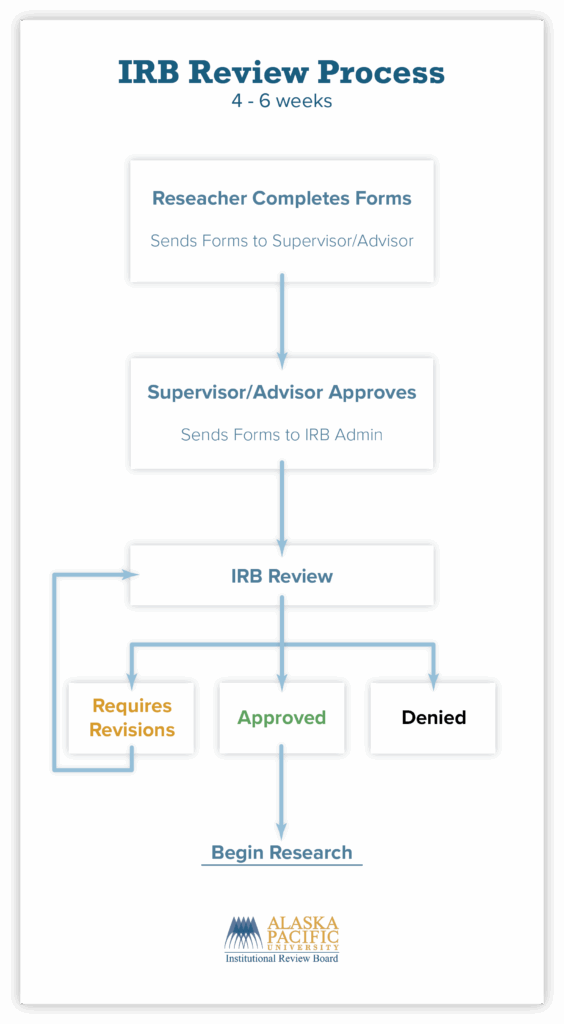
The APU IRB Review process is an interactive process that allows for review and revisions. As such, it can take up to four weeks for the IRB to perform their due diligence and recommended revisions to be made. All applicants should apply well in advance of their project deadlines. 

When a proposal is received, the IRB Administrator will assign the initial review to two IRB members for their review. If they have any concerns that need to be addressed, the IRB Administrator will return the proposal back for revisions. The revised proposal will be returned again to the IRB members for their final review. If approved, a formal letter of approval will be sent. 

Review Scheduling Tips

For student and advisors, please take note of the Senior Projects Day and work backwards from there. Schedule your time to allow for IRB proposal development and document collection, a four-week IRB review, conducting your research, and preparing your final Senior Project.

For faculty and staff, IRB proposals can be submitted at the same time as submitting a Notice of Intent to Apply (NOIA) for External Funding and no later than immediately following notification of an award.

For more information about submitting a grant proposal, visit our Office of Sponsored Programs page.
IRB Proposal Requirements


Note: APU No longer uses IRB Net to manage the IRB Review process.

All submissions must be sent by email with attachments to IRBSubmission@alaskapacific.edu. If you are a student, please send your email to your advisor first and ask them to forward your proposal with attachments included to IRBSubmission@alaskapacific.edu.

You may use this researcher checklist throughout your submission process to ensure you have completed all IRB requirements.

Include in your submission:

Students should work with their advisor to develop a proposal that is approved by the advisor. Faculty and staff should work with their department/institute supervisor to develop a proposal that is approved by the department/institute supervisor.

A full proposal will include information related to each of the following categories:

  •  Project overview, title, purpose, and concise research question (s)
  • Background rationale and summary of key literature supporting the proposed research project
  • Methods, including a detailed research protocol
  • Risk and benefit assessment with plans to minimize risk
  • Confidentiality and data-management plan
  • Complete consent information, including scripts

Both of these forms are required to be submitted together for an IRB proposal.

Use the Letter of Consent Template to draft a standard letter you’ll provide to participants. Make sure it includes your contact information, and also contact information for your advisor/supervisor.

Be sure to document any needed permission for your study. Many researchers work in cooperation with non-APU organizations, or on the property of other institutions. If this is true of your study, you’ll need signed letters providing permission to do your work. Likewise, if your activities require permits from government or other agencies, please attach them.

If you plan to interview or survey people, include with your proposal a list of the questions you’ll be asking or information you’ll be requesting.

If you plan to create and distribute any materials to promote your research such as fliers, invites, brochures, etc., APU’s branding rules must be followed. Ensure that your materials have been well-edited and proofed prior to submitting for IRB Review and before posting or publishing.

A certificate that shows completion of a Responsible Conduct of Ethical Research (RCER) training is highly recommended by the IRB. Discuss with your advisor or department/institute supervisor if a certificate is recommended for you and your project. 

Principal Investigators of federal grants are responsible for complying with requirements to ensure undergraduate students, graduate students, and postdoctoral researchers receive RCER training. If you have completed CITI Training, please include a pdf of your certificate with your proposal. The IRB Administrator keeps a record of all current RCER certificate holders. Most CITI trainings are valid for three years. 

Class projects conducted in an educational setting by faculty or by students under direct faculty supervision do not require IRB approval, but the required submission of this form provides an opportunity for IRB review and feedback. To receive IRB feedback, you must submit the Class Projects Involving Human Participants or Animal Subjects Review Form.

Submit the form to IRBSubmission@alaskapacific.edu prior to conducting the research. If you are a student, please send your email to your advisor first and ask them to forward your proposal to IRBSubmission@alaskapacific.edu. If you are faculty, please note that if students in your class are independently designing and executing their own studies, each study will need to be submitted for individual review.

Helpful Tips


  • The easier all forms are to read and review, the faster the IRB can complete their review. Thoroughly edit all forms for grammar and completeness. The IRB approval forms ask for specific information; include it all.
  • Clearly state how your human research subjects will be selected and treated.
  • Be thoughtful and explicit about how you’ll protect the privacy of your human participants. The highest level of protection is an anonymous study where nobody, including the researcher, will know the identities of the participants. Many studies are not anonymous, but promise confidentiality, where the final research report will not associate their responses with their names/other identifying information. If you’re doing the latter, explain how you’ll make sure that research materials involving participant identification are either destroyed or provided lasting protection. And think about whether your research design might allow readers to “guess” the identities of your participants.
  • If your research will cause discomfort, harassment, or harm to the human participants, document this clearly and then explain how you’re striving to minimize it. And be sure to explain why the benefits of your research outweigh these costs. 
  • Adhere to all local, regional, and federal laws and regulations.
  • Seek guidance for ethical standards in your field. Some examples:
  • American Psychological Association
  • American Association for the Advancement of Science (human subjects)

Responsible Conduct of Ethical Research


What is RCR?

Responsible Conduct of Ethical Research (RCER) refers to training that ensures that faculty, staff, and students who conduct research do so in a responsible and ethical manner. Federal, state, and/or private agencies may require RCER training and in accordance with APU’s Training in RCER Policy. Principal Investigators applying for grants are responsible for ensuring any RCER training compliance. RCER compliance may be required as part of a grant proposal or immediately upon notification of award depending on the grant and agency.

For agencies requiring RCER training, Principal Investigators are responsible for:

  • providing training for undergraduate students, graduate students, and postdoctoral researchers in accordance with federal agency requirements.
  • submitting a RCER training plan immediately following the award notification to the Office of Sponsored Programs at sponsoredprograms@alaskapacific.edu
  • providing proofs of training completion such as CITI Completion Certificates of all trainings conducted as part of the RCER training plan to the Office of Sponsored Programs at sponsoredprograms@alaskapacific.edu

The RCER training plan must include:

  • the start date of student research activities
  • the titles of each of the training course students and researchers will take
  • training courses from one or more of the following options:

APU faculty, staff, and students have free access to RCER training and other research related courses through the US Department of Health and Human Services. If you are interested in training, click here.