Rooted in Reciprocity: The Alaska Resilience Farms Story
Building Food Sovereignty Across Alaska
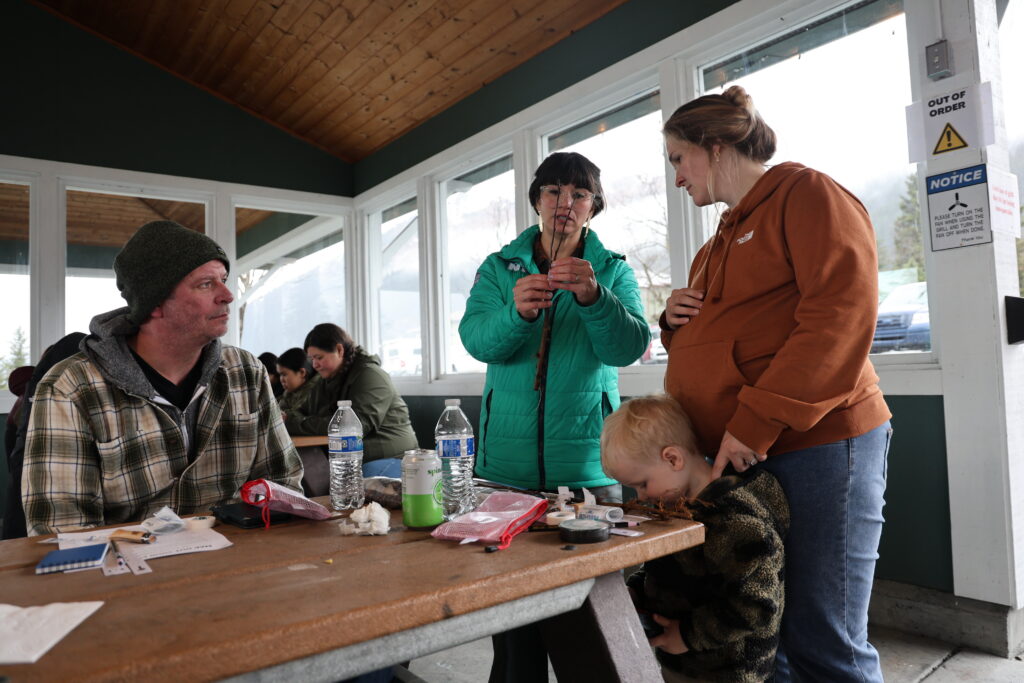
People of all ages gather under a pavilion in Seward, Alaska, carefully grafting scion wood to root stock in hopes of growing something special in Alaska: apple trees. The gathering, held on the homeland of the Sugpiaq People, was one of many community events hosted by the Alaska Resilience Farms (ARF) collaborative throughout the year.
ARF was created in response to Alaska’s changing climate and growing concerns around food insecurity, particularly in rural communities. What began as a small partnership has grown into a statewide network that includes Alaska Pacific University’s Spring Creek Farm, Alaska Conservation Foundation, Newhalen, Kake, Tlingit and Haida, the Native Village of Eklutna, Kodiak Archipelago Leadership Institute (KALI), and the Chugach Regional Resources Commission (CRRC). Together, the partners work to strengthen local food systems, support sustainable agriculture, and advance food sovereignty through relationship building, knowledge sharing, and collaboration.
Knowledge Exchanges Rooted in Reciprocity

ARF’s early work focused on hosting “Knowledge Exchanges” across Alaska. The term was chosen intentionally to move away from the traditional idea of a workshop, which is a colonialized word that implies a one-way transfer of knowledge. Instead, Knowledge Exchanges recognize that every community member brings valuable experience, skills, and cultural knowledge to share. These gatherings create opportunities for Indigenous communities in rural and urban areas to connect, collaborate, and learn from one another while building a statewide support network around agriculture and food systems.
APU Agriculture Education Educator Alex Wilson reflects on the impact of these partnerships, saying, “The sense of community, distilling of knowledge into our group, and making connections with village communities is amazing. It’s really neat to see how things are done differently around the state, rural and urban, and then being able to use that knowledge in other places so that you don’t have to reinvent the wheel every time.”
Growing Community Gardens Across Alaska
In 2022, ARF expanded its work by helping communities re-establish and strengthen local gardens. If invited by a local Garden Champion, in coordination with tribes and villages, ARF teams travel to communities to help build infrastructure and support ongoing garden projects. Many partner communities, such as Newhalen, Iliamna, Kake, and Rampart, are now entering their third or fourth growing season! As these gardens continue to develop, the focus has shifted away from the initial revitalization or creation towards learning what works best in each location and adapting projects to meet the unique needs of each community.
A Statewide Network of Support
The latest Knowledge Exchange took place in Seward in partnership with Alaska Pacific University’s Kellogg Campus, Native Village of Eklutna, KALI, the Qutekcak Native Tribe, and the Alutiiq Pride Marine Institute, which is a division of CRRC. Participants from across Alaska gathered to share ideas and hands-on learning opportunities centered around food sovereignty and sustainable growing practices. The first session focused on apple tree grafting, led by APU’s Alex Wilson. The next two days focused on hydroponics education led by KALI Program Director Max Lyons and Sustainable Food Systems Technician Joe Kewan. CRRC’s Healthy Foods Coordinator Allie Toloff also gave a tour of the hydroponics operations at the Alutiiq Pride Marine Institute.

“I think it’s really powerful bringing growers together from different communities and building that relationship,” said Lyons. “Building that farming family and that network is crucial for food sovereignty. Especially in remote, rural areas, it can feel isolated, so it’s cool to have people you can jump on a Zoom with or call up and get support, energy, and ideas from.”
The Alutiiq Pride Marine Institute is just one example of the many organizations working with land, water, and people. Examples of its broader work include marine research, mariculture, kelp farming, and ocean health initiatives like toxicology studies. Toloff also recently expanded the institute’s work into hydroponics with the help of fellow ARF partners like Lyons and Kewan. Toloff reflects that, “It’s really inspiring to be around people who are doing similar things as you and to see how passionate we all are. I feel blessed for that.”
Advancing Food Sovereignty
At its core, ARF’s mission is to strengthen food security and food sovereignty throughout Alaska. Many remote communities rely heavily on expensive freighted foods due to the long-term impacts colonialism had on traditional Indigenous food systems.
Newhalen Garden Champion Evelynn Trefon remarks that “People are more dependent on the stores more now than ever now… Hopefully, through Alaska Resilience Farms, it will transition to people having more home gardens now, especially with the high cost of things. It’s way cheaper to plant a three-dollar packet of seeds than to import vegetables.”

Trefon wears many hats in her community. She is the secretary at the Newhalen school, serves on the city council and the board of the electric co-op, and runs a produce stand selling fruits and vegetables to the community. As the Garden Champion, she spearheads the community garden kick off, coordinates with local community members when ARF comes to town, and manages the garden throughout the summer. Through ARF, she’s also gotten connected with local farmers in the Matanuska-Susitna Valley and now buys carrots directly from Singing Nettle Farm in order to sell them at her produce stand!
In addition to supporting agriculture projects, ARF partners are helping restore native foods and plants back into communities through a United States Forest Service (USFS) Food Forest Grant. The collaborative blends traditional cultivation knowledge with western agricultural practices to support long-term community resilience and self-sufficiency.
Looking Ahead
This summer, ARF partners will visit five different communities to continue supporting local gardens. The APU Kellogg Campus also plans to expand its food forest efforts, which combine annual vegetables, berry bushes, fruit trees, and other perennial foods into layered growing systems designed for long-term sustainability. To this end, Spring Creek Farm manages the Dan Elliot Orchard and will continue to share apple saplings and cuttings with communities interested in growing orchards locally.

The work of ARF is primarily supported through funding from the NoVo Foundation and a USFS grant focused on food forest curriculum development. The NoVo funding recently directed its capital for this project into the Ishkode Fund, which is an Indigenous-led public charitable fund designed to shift grant-making decisions and resources directly into the hands of Native leaders.
APU Kellogg Campus Director Kelly Marciales says the partnership continues to grow each year: “Each year it continues to grow and get better. With NoVo Foundation funding until 2030, we’re able to plan out work beyond a year, which is really helpful. We’ve grown from a handful of relationships to a network that spans half of Alaska and we hope to reach communities and growing zones in the next couple of years that we haven’t been able to yet.”