Weather on the Ice: Understanding weather patterns on the Dixon Glacier
APU student Dan Dillehay spent several days in spring 2023 commuting to his research site by taking helicopter rides over 100 miles of snow-capped mountains. Dillehay, receiving a marine and environmental science degree, took on a senior project gathering weather data from the previously undocumented Dixon Glacier, which is located in the Kenai National Wildlife Refuge. The Dixon Glacier is part of an expanse of ice that stretches over 10 miles of mountainous terrain, with enough meltwater to attract the attention of The Alaska Energy Authority.
AEA, a public corporation aiming to reduce energy costs in Alaska, diversify Alaska’s energy portfolio, and invest in infrastructure, is considering diverting water from the Dixon Glacier into Bradley Lake to generate renewable energy for the state. But understanding how Southcentral climate change will shape the future of the glacier is critical before funding a multi-million-dollar project. Knowing weather patterns on Dixon Glacier will help predict the longevity and reliability of the glacier.

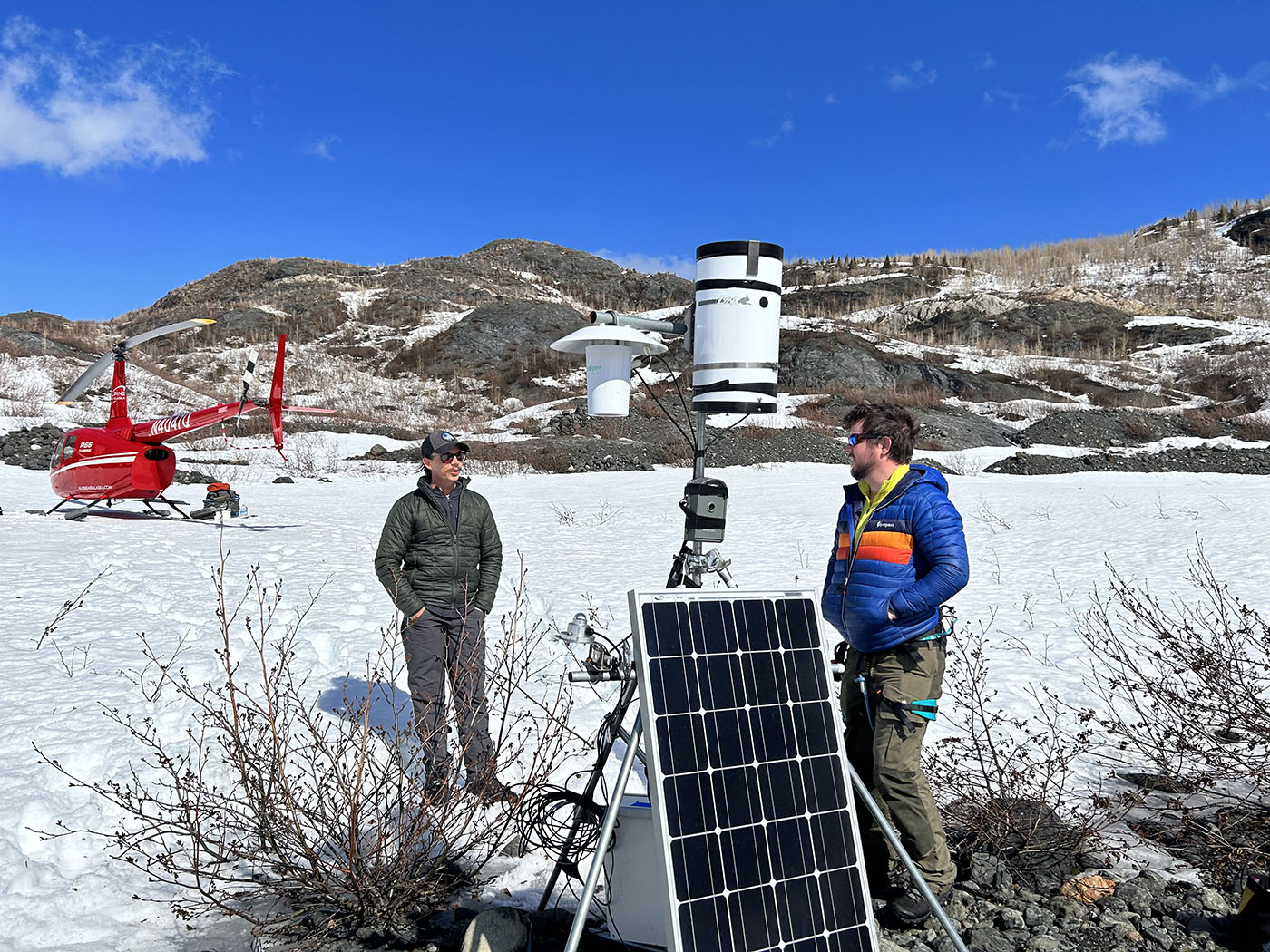
Dillehay worked with Jason Geck, a professor and long-time researcher of Alaska’s glaciers, to install three weather stations along the expanse of the glacier. Each installation site provides information from key positions on the glacier. One station was installed on the terminus of the glacier, where ice melts away; one in the middle, where the ice stays at an equilibrium; and one at the top, where snow and ice accumulate to feed the glacier’s growth.
“Like everywhere in Alaska, there’s microclimates every 10 feet, so you can’t really judge one place based on another,” Dillehay said.
An eight-hour day of work looked like this: “Drive down to Girdwood, hop in a helicopter, and then the helicopter would land and we would unload all the weather station stuff,” Dillehay said. “So, unload it, put together the weather station, plug in all the wires and stuff, make sure everything’s working, and then head back.”
The weather stations are around six feet tall and made from metal tripods with a solar panel on one side. Each station has to be broken down to fit in the helicopter before being bolted together into a tripod shape on site. Then, various instruments are affixed to the framework and connected to a computer that collects and stores the data. The Dixon Glacier project is being funded by the NASA Space Grant, which sponsors a network of universities and research projects across the nation.

“Dixon hasn’t really been studied before, and so we don’t really know what a normal summer looks like,” Dillehay said. Other glaciers in Southcentral Alaska—such as the Eklutna glacier, which provides Anchorage water—have been heavily watched and studied, but the Dixon has remained relatively overlooked.
Dillehay, 39, moved to Alaska in 2003, received a bachelor’s degree in political science from UAA in 2008, started a family, and in 2019, opened an outdoor education business, Into the Woods Alaska, with his wife, Kristina. Even with the family business running well, he came back to university in 2020 for a marine and environmental science degree. Dillehay’s plans include finding a secondary job outside the family business, noting his interest in pursuing environmental consulting, like checking jobsites for viability in construction or mining projects.
Dillehay began working with Geck after he took a couple of undergraduate courses with the professor. In 2023, Dillehay joined Geck for fieldwork that involved Eklutna Glacier stream discharge measurements, which measured the amount of water coming from glacier meltwater. Based on his efforts with the stream research, Dillehay was brought into the weather station project.
When comparing his current work to the papers he wrote for his political science degree, Dillehay said he learned a lot more practical skills with the hands-on glacier work.
“I actually do research myself and I get to see where it’s all coming from,” he said.
In 2023, the weather stations remained in place from May to September, but the research will not end there. To create a better understanding of the climate patterns along the glacier, weather stations will be re-installed each spring, providing researchers with a detailed catalogue of weather data for the glacier.
Despite hauling large pieces of equipment onto glaciers during long days of field work, Dillehay said that the hardest part of the project was balancing university with a full-time job and two kids in middle and elementary school. Dillehay said that he considered himself lucky both to have his wife, who pitched in to allow him more time for his studies, and to be attending APU, with flexible course schedules.
“I’ve always been interested in science,” Dillehay said. “I spent a lot of time in the mountains and outside and just looking at stuff, and you want to know how it works,” he recalled. “I never really thought I could be a scientist, but as I got older, I realized if I put the work in, I can do whatever I want.”
Article written by graduating student Laura Ditto as part of her senior project, Science in Progress: Reporting on Research at APU.